
There is a way of exploring the Rias Baixas that most travellers do not know about: the local Galician commuter train. A line connecting Vigo, Redondela, Pontevedra, Padron and Santiago de Compostela, running close to the ria and through some of the most beautiful coastline in northern Spain.
It is not a high-speed service. It is a regional train, inexpensive, and in certain stretches it runs so close to the water that it almost seems about to get its wheels wet. If you travel without a fixed schedule and want to see Galicia properly, this line is one of the region's best-kept secrets.
The Galicia Cercanias Line: What it is and How it Works
Renfe operates a commuter network in Galicia connecting the main towns of the province of Pontevedra with Santiago de Compostela. The key line for visitors is the C-1: Vigo to Santiago, stopping at Redondela, Pontevedra, Caldas de Reis and Padron.
Trains run frequently during morning and evening rush hours, every 30 to 45 minutes between the main towns, with longer gaps in the middle of the day. The full journey from Vigo to Santiago takes roughly one hour and twenty minutes.
- Vigo to Santiago: Approximately €5–7 on the local Cercanias service (2025 fares)
- Redondela to Pontevedra: Under €3
- Redondela to Vigo: Under €2
Local train fares in Spain are among the cheapest in Europe. Combined with the right accommodation, this is one of the most affordable coastal itineraries on the continent.
Stop by Stop: What to See in Each Town
Vigo
The largest city in Galicia by population. A working port city with a great deal of character and some of the best seafood eating in the Rias Baixas. The Mercado da Pedra in the city centre is the place to go for oysters: they are opened to order on the spot and eaten immediately, standing at the stall, with a squeeze of lemon and a glass of white wine. No tablecloth, no menu. As direct as it gets.
Vigo also has the best concentration of seafood restaurants in the Rias Baixas and a direct ferry service to the Cies Islands. If you have a free day, Vigo fills it comfortably.
Redondela
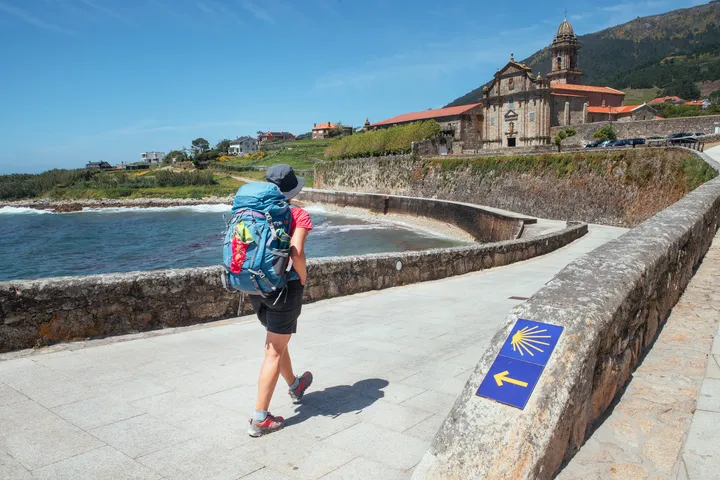
Fifteen minutes from Vigo by train. Redondela is the southern gateway to the Rias Baixas on the Portuguese Camino and is defined by the nineteenth-century stone viaduct that spans the town, one of the most photographed landmarks in all of Galicia.
The old quarter is small, peaceful and free of crowds. The waterfront promenade looks out over the Ria de Vigo. And the local food is at the level you would expect from a Galician coastal town.
Redondela is also the ideal base for exploring the wider area without a hire car. From here, by train, you can reach Vigo, Pontevedra and Santiago in under 40 minutes in any direction.
Pontevedra
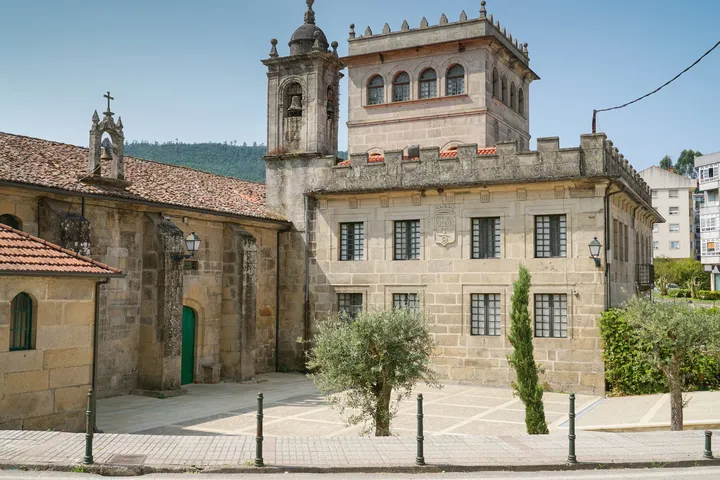
Twenty minutes from Redondela. Pontevedra has one of the best-preserved medieval old quarters in Galicia, fully pedestrianised and full of bars, café terraces and squares with genuine local life. This is not a historic centre maintained for visitors; it is where people actually live and work.
The Basilica of Santa Maria la Mayor, the Pontevedra Museum and the ruins of Santo Domingo are the main cultural landmarks. But the best thing about Pontevedra is simply wandering its streets without a particular destination in mind.
Caldas de Reis
A small town well known for its natural thermal springs. In the centre, hot water rises from the ground through a series of public fountains, in winter there is a faint curl of steam in the air that gives the place an agreeably ancient feel. There are spas and bathhouses if you want something more organised, or you can simply soak your feet in the public fountain as the locals do.
Caldas is also on the Portuguese Camino, so in high season you will share the streets with pilgrims. Two or three hours is enough to see the whole town.
Padron
Padron has two things worth knowing about: the Padron peppers (which were named after here, not the other way round) and its connection to the Jacobean story. According to tradition, this is where the boat carrying the body of Saint James first made landfall in Galicia.
The Collegiate Church of Santa Maria la Mayor holds the pedrón -the stone to which the boat was moored- in its crypt. It is one of those small places that carries a weight of history and legend entirely out of proportion to its physical size.
In August the town holds its annual Pepper Festival, which is exactly what it sounds like and is well worth the trip if your timing works out.
Santiago de Compostela
The end of the Camino. The cathedral, the Praza do Obradoiro, the particular quality of noise and silence that coexists there. Santiago works perfectly as a day trip from Redondela or Pontevedra. The train drops you ten minutes on foot from the cathedral.
For non-pilgrims, Santiago also has excellent museums, outstanding food and a university population that keeps the city lively all year round.
How to Plan the Journey by Train
The simplest approach is to buy tickets through the Renfe app or website. You can also buy them at the station on the day, though queues can build up at busy times in summer.
A practical strategy for a two or three-day trip is to use Redondela as a central base: by train you are equidistant between Vigo and Pontevedra, and less than forty minutes from Santiago in either direction. You can travel light each day and return to the same apartment each evening, no daily repacking, no check-in routine.
- Day 1: Vigo in the morning, back to Redondela for the afternoon. Waterfront walk and dinner.
- Day 2: Pontevedra for the full day. Old town and a proper lunch.
- Day 3: Santiago de Compostela. Cathedral, the Obradoiro square and the covered market.
Check timetables on the Renfe app before you travel. Frequency can vary on public holidays and weekends. There is also a discounted Cercanias card worth considering if you are planning to use the trains for more than two days.
Why This Journey Works Better Without a Car
Hiring a car in Galicia in summer has its costs. And finding a parking space in central Pontevedra or Vigo in August requires patience that most people on holiday simply do not have.
The train removes all of that. It is also, frankly, the more interesting way to travel: from the window you see the ria, small villages and eucalyptus forests that no motorway ever shows you. And when you arrive, you step directly into the town, no car park, no getting your bearings from a petrol station on the ring road.